
How to deploy AI in real operations
Redesign work in the age of AI
AI does not deliver value through isolated use cases. It delivers value when workflows are redesigned, deployed on a governed backbone, and adopted into daily operations.
Most organizations stall because they treat AI as experimentation, not execution.
What does an effective AI response look like?
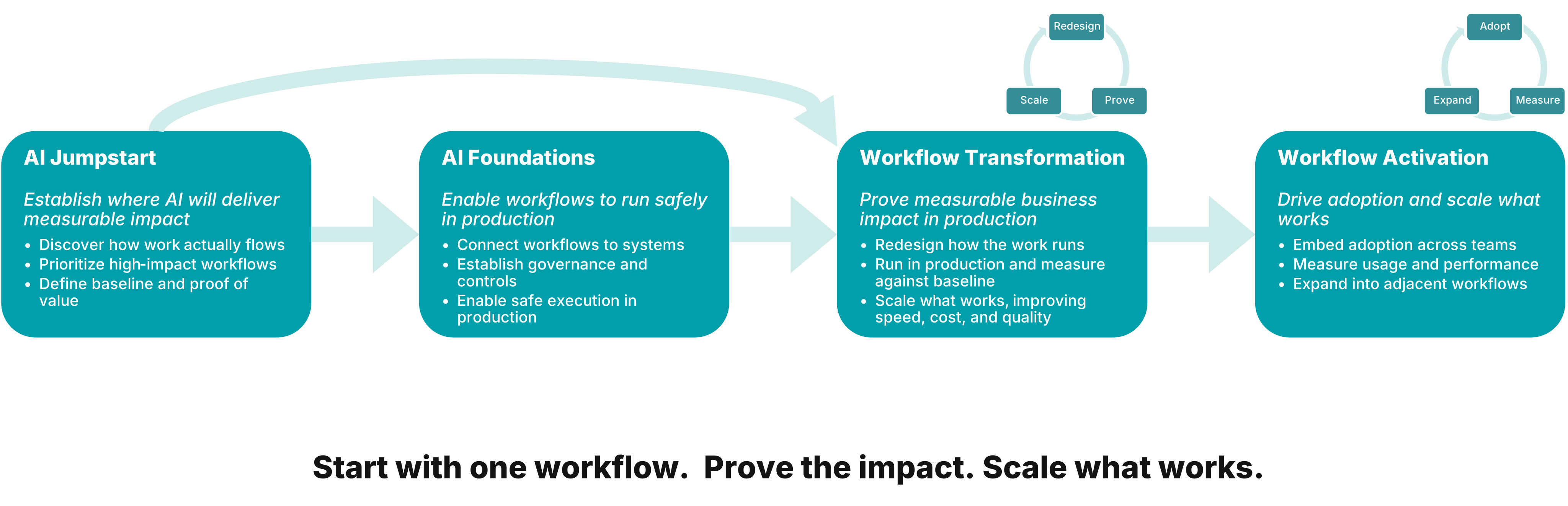
Organizations that successfully deploy AI follow a consistent pattern. They start with a focused, measurable workflow. They ensure systems are ready for production. They redesign and measure in real operations. And they sustain results through adoption and expansion.
This is not a roadmap. It is a structured execution model. Each stage defines a clear objective, a measurable outcome, and a decision point before moving forward. Not every workflow follows the same path - Foundations and Transformation can run in parallel, and some workflows move directly from Jumpstart into Transformation.
Outcomes are defined upfront, measured in production, and tracked over time.
Decide where AI will deliver measurable impact
Select a high-impact workflow, establish baselines, and define proof-of-value before execution begins.
AI Jumpstart helps executive teams select a workflow where impact can be proven, establish baselines, and define how to act.
2-3 weeks · Executive-led · Paid · Fixed scope
You receive
- Executive alignment deck on AI priorities and ambition
- Scored workflow shortlist ranked by value, feasibility, and risk
- Economic evaluation model with baseline metrics
- Proof of Value scope document with defined success criteria
- Go/no-go recommendation with clear decision framework
This stage establishes the baseline and defines how success will be measured before implementation begins.
Enable secure, production-grade AI execution
A focused 2-3 week engagement that defines the security posture, validates the data access pattern, and produces an executive go/no-go decision before workflow build begins.
Most AI work stalls on unresolved security, data access, and governance questions. The AI Foundations Sprint resolves them in two to three weeks. Foundations and Jumpstart can run in parallel.
2-3 weeks · Senior-led · Paid · Fixed scope
You receive
- AI Security and Privacy Posture Brief
- Secure AI Data Access Architecture
- Validated access pattern in a controlled environment
- Recommended workflow candidate for transformation
- Executive go/no-go decision before capital is committed
Foundations enable controlled deployment, measurement, and repeatable scaling.
Deploy workflows that produce measurable results
A 3-week Transformation Sprint produces the plan and baselines. Architech builds the workflows that follow. Fully transformed workflows, scaled and adopted, within 90 days.
Most enterprise AI work stalls between approved roadmap and shipped workflow. The Transformation Sprint closes that gap in three weeks, producing a plan of record with named owners, baselines, and acceptance criteria. Architech then builds the workflows into production using the same architecture and baselines established during the Sprint, with adoption embedded from day one.
3 weeks · Senior-led · Success-based · Fixed scope
You receive
- Sub-Workflow Deep Dive with cost baselines and impact projections
- Workflow Transformation Atlas with priority scoring across workflows in scope
- Prioritized Sequencing Plan with named owners and 30/60/90 milestones
- Measurement baselines captured before transformation begins
- Acceptance criteria documented and agreed in Week 1
The Sprint produces the plan. Architech delivers the build that follows.
Drive adoption, validate performance, and scale what works
Deployment is not the finish line. 70% of AI adoption failures are people and process failures, not technical ones. Adoption is embedded from day one, not bolted on at the end.
You receive
- Adoption playbook with role-specific training materials
- Performance dashboards and KPI tracking
- Expansion prioritization for adjacent workflows
- Governance framework for ongoing AI operations
- Continuous optimization and horizon scanning for new capabilities
A workflow is only successful when it is adopted, measured, and producing consistent results.
See what this looks like
in production.
Real workflows. Measured results. Validated against baseline.