
Stop waiting for perfect data to start with AI
Somewhere on your roadmap, an AI initiative has been parked for a quarter behind a six- or seven-figure data-modernization program. The pitch sounded right: fix the data first, then the AI. For a narrow set of workflows that pitch is correct. For most of the AI value an operator can capture this quarter, it is not. The right scope is the workflow, not the enterprise. Ask what data this workflow actually needs, and where it already lives.

Published May 6, 2026 · Updated August 1, 2026
Somewhere on your roadmap, an AI initiative has been parked for a quarter or more, waiting for a data project to clear. The pitch was reasonable when you signed it. Before the AI work could start, the firm explained, the data had to be fixed. An assessment would scope the gap. A modernization programme would close it. The AI roadmap would follow. Eighteen months and six or seven figures later, the AI work would begin. You agreed, because the firm was credible and the logic sounded right. Now you have a quarterly review next week, a board that wants to see AI working somewhere, and a roadmap that keeps slipping to the right.
The default consultant pitch is that before you can do AI, you have to fix your data. For a real but narrow set of AI work, that pitch is correct. For most of the AI value you can capture this quarter, it is not. The difference is which workflow you are talking about, and almost nobody making the data-first pitch is being precise about that.
The pattern is mature enough to name
The data-readiness assessment as a precursor to AI is now a recognizable category. Data-modernization consultancies have packaged it as a service. Large advisory firms have productized it. The shape is consistent across providers: a maturity model with several levels, foundational data readiness as the first level, AI somewhere later and conditional on clearing the levels below. The pattern has spread far enough that operators can name it, which is what makes a piece like this possible. You have either bought a version of it, been pitched a version of it, or watched a peer company budget for one.
Two facts make the asymmetry visible.
The price of the tooling has collapsed. Business-grade AI tools are $20 to $30 per person per month. Claude Team. ChatGPT Business. Gemini Workspace add-ons. They accept the PDFs, Word files, and spreadsheets your team already has and pull structured answers out of them, with no connection to your core systems required.
The price of the wait has not. Mid-market data-modernization projects are routinely scoped at six or seven figures over nine to eighteen months. When the practical version of the workflow could be running in two weeks on a $200-a-month team licence, whether you should be waiting at all stops being an abstract question. It is a calendar decision worth a quarter of your AI plan.
Both numbers are public. The asymmetry is not subtle. What the data-first pitch quietly assumes, and what most operators do not push back on, is that the workflow you are trying to ship needed to wait in the first place.
The right scope is the workflow, not the company
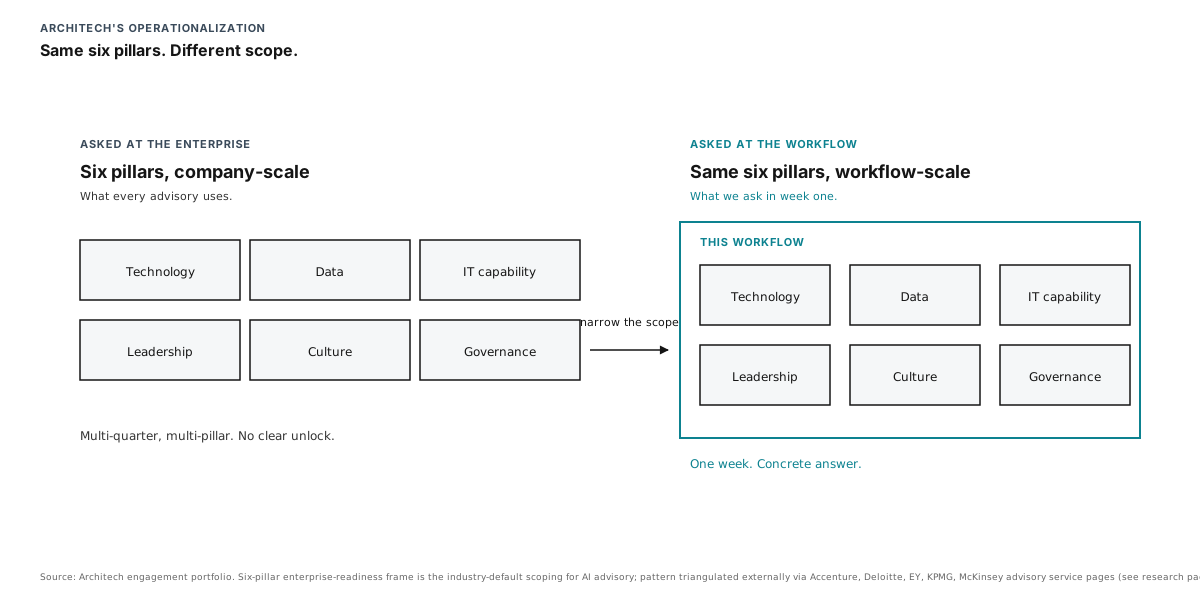
We ran this experiment on our own work. The first AI Jumpstart we delivered was scoped the way every major firm scopes AI advisory: company-wide readiness across six pillars, covering technology, data, IT capability, leadership, culture, and governance. That was the industry default at the time. Across the engagements that followed, what we were assessing kept shrinking. Not the methodology. Not the rigour. The scope.
What we found was steady. At the company level, AI readiness is a multi-quarter question across half a dozen dimensions with no clear finish line. At the level of one workflow, it is a one-week question with a concrete answer. Same client, same data, same team. Narrow the scope from the company to a single workflow and the readiness barrier either disappears or turns into a small, scoped piece of engineering.
That is why AI Jumpstart now sits in the operator's calendar as a decision, not an audit. We watch the work as it actually runs in two or three areas of the business, build a shortlist of the workflows where AI would pay off, agree what each one would be measured against, and end in a go or no-go. When a workflow does need systems work first, that is a separate piece of design we sell on its own terms: the AI Foundations Blueprint answers how AI connects to your systems safely, designed once and reused by every workflow after it. It is not a stage you have to pass through, and it is not a precondition we attach to everything. It is bought when the systems questions are the real question.
 The scope shift mattered because it lined up with where the value actually is. McKinsey's March 2025 State of AI tested 25 organizational attributes against profit impact from generative AI.
Redesigning the workflow had the single biggest effect on profit. Only 21% of companies using generative AI have fundamentally redesigned even some of their workflows.
The other 79% have layered AI on top of the existing process, or are still waiting on the foundation. BCG's 10-20-70 framework, published in September 2025, lands the same point from the cost side: about 10% of AI value comes from the algorithms, 20% from data and technology, and 70% from people and process. Data and technology are real and they matter. They are also one fifth of where the value is. The data-first pitch routinely treats them as the whole.
Two lists, calibrated
There are two kinds of AI workflow on your roadmap.
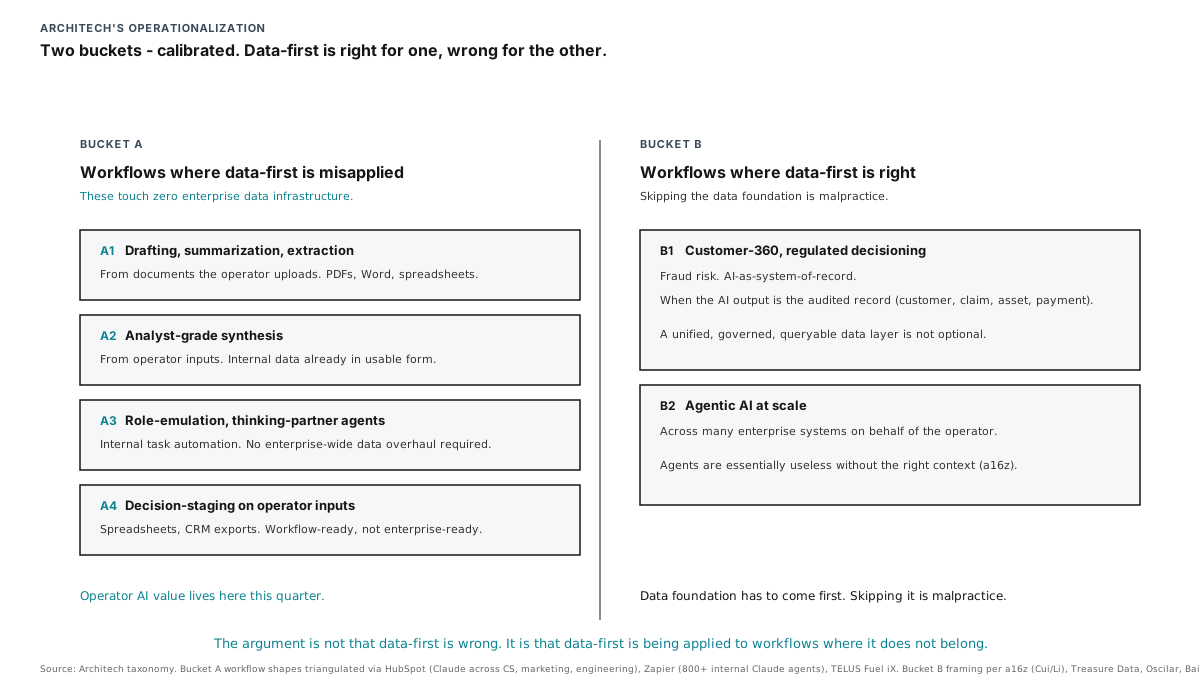
List A. Workflows where the data-first wait does not apply.
Drafting, summarizing, and pulling numbers out of documents your own team holds. A finance team pulling figures out of vendor invoices. An HR team drafting first-pass policy answers against the employee handbook. The material is already on a laptop or in a SharePoint folder. There is nothing to connect and nothing to wait for.
Analyst-grade answers built from inputs you already control. HubSpot deployed Claude across customer success, marketing, and engineering by connecting it to internal services it already ran. Customer success managers cut escalation troubleshooting from three to five days down to under an hour. What made that possible was a connection to data the firm already controlled, not a data-modernization programme.
Agents that stand in for a role or act as a thinking partner. Zapier runs more than 800 internal Claude-driven agents across engineering, marketing, and customer success, and the internal task volume going through them grew tenfold year over year. None of it needed a company-wide data overhaul to ship.
Preparing a decision from inputs the operator already owns. A pricing model fed by your own spreadsheet. A sales-call coaching agent fed by your own CRM exports. The data does not have to be fit for the whole company to be fit for this one workflow, which is a much smaller question.
List B. Workflows where data-first really is the right call.
A single view of the customer, regulated decisions, fraud risk, and anywhere the AI's output becomes the record. When what the AI produces is the audited record of a customer, a claim, an asset, or a payment, the foundation has to hold up under audit. One governed, queryable data layer is not optional. The analyst and vendor consensus on this point is consistent and well defended.
AI acting on its own across many of your systems at once. When an agent has to reason across a dozen enterprise systems on your behalf, the problem of giving it the right information is real and serious. As one venture firm's analysis puts it, agents working over your data are close to useless without the right context around them.
The argument is not that the data-first pitch is wrong. The argument is that it is being applied to workflows where it does not belong.
The working example
We worked with a professional services firm to rebuild how they produced sales proposals at volume. What the redesigned workflow needed was their past proposals and their service catalogue. Both were already on disk. The firm's legacy ERP carried substantial data-quality problems and was not part of this workflow at all. Had readiness been scoped at the company level, the ERP would have blocked the AI work for quarters. Scoped at the workflow level, the ERP was simply not in the picture.
The redesigned workflow cut the effort to produce each proposal by roughly 80% and moved non-billable senior time into billable work, worth several million dollars a year. The data foundation the data-first pitch would have insisted on was not the bottleneck. The workflow design was.
The same logic plays out in our own shop. The pipeline that shipped the post you are reading runs on version control, a set of AI agents with separate jobs, an outside language model, an outside image model, and an outside CMS. There is no data lake behind it. There is no single view of the customer. There is no data programme it had to wait for. We told the longer version of that story in the piece about redesigning our own content workflow. It is a second example of the same pattern.
The strongest counter-position, taken seriously
The data-first case is not weak and it is not made by quiet voices.
Through 2026, Gartner expects organizations to abandon 60% of AI projects that are not supported by AI-ready data.
Bain frames a real data strategy as a core enabler of AI value rather than a nice-to-have. Fortune's coverage of AI acting at scale puts it harder still: what looks like a capability problem turns out to be a data problem, a failure to make data accessible, consistent, and usable across systems, and no amount of model improvement fixes it. The same article notes that 80% of companies name data limits as the main obstacle to scaling AI.
Taken on its own terms, that position is correct. For any AI workflow that becomes the record, makes regulated decisions, depends on a single view of a customer, or acts on its own across many systems, the data foundation has to come first. Skipping it is malpractice.
This piece makes a narrower claim: the data-first pitch is misapplied when it is applied universally. It is right for List B. It is wrong for List A, and List A is where most of the AI value you can capture this quarter sits.
Practitioners closer to the work say versions of the same thing. One Salesforce executive described the posture as working backwards from what you need: put something into real use, watch it, scale it, then do the next one. One head of technology strategy at a large bank made the case that instead of treating imperfect data as a constraint, you can ask how AI might help improve and connect the data you already have. Both are arguing the same thing from different chairs: start with the workflow, not the company.
The question to take into your week
Pull up the AI initiative at your company that has been parked the longest. Look at why it is parked. If the answer is some version of "we are waiting for the data project," ask whoever owns it one question.
What data does this workflow actually need, and where does it already live?
The answer will be one of two things. Either the workflow belongs on List B, the data really is the bottleneck, the modernization programme is the right path, and the parked status is correct. Or it belongs on List A, the data it needs is already on disk somewhere your own team controls, and the foundation you are paying to build is blocking something that never needed it.
That second answer is more common than the data-first pitch admits. When you find one, you have a workflow that could be running in two weeks on a $200-a-month team licence instead of in eighteen months at six or seven figures. The same posture the one-claim test argued from the homepage side applies here: you are the judge, not the audience. Test us on it too. If the answer turns out to be "we do not actually need the assessment for this one," that is the conversation worth having before next quarter's review.
See where AI will pay off in your operations.
Pick one workflow that matters to you and answer a few focused questions. You get a workflow-specific read on where AI can move a real number for you. It also names what stands in the way and the right first step for your situation.
A clear read on the one workflow you choose, not a generic AI-readiness label or a roadmap you will never use.
Email required after the fifth question. Your results are built around the workflow you name.
What you receive
- A workflow-specific read on the one process you choose, not a generic AI-readiness label
- The risks that would block, slow, or add cost to change, and the minimum work to clear each one
- A view of what a short self-serve scan can and cannot see
- One recommended first step, reasoned from your own answers
- A three-line summary you can forward to a CFO or CEO in one paste
Prefer to go straight to scoping, or talk to an engineer?