
The model was never the hard part
You have watched it happen. A pilot demos beautifully in the boardroom, then meets real data and real handoffs and quietly never reaches production. It was not a weak model. The model was never the hard part. A durable AI build is a system built underneath the workflow: the data foundation, the redesigned process, and the measurement that runs for as long as the workflow does. That is where the advantage sits, and where most vendors spend the least.

Published July 16, 2026 · Updated August 1, 2026
You have seen this one. A pilot demos beautifully in the boardroom. The answers are sharp, the summary is clean, and someone says out loud that this changes everything. Then it goes to the operations team. It meets real data and real handoffs, and it quietly never goes live.
MIT research found that 95% of enterprise AI pilots deliver no measurable ROI. The cause was not model quality. It was that generic tools could not adapt to how the work actually runs. Not a weak model.
Why the good demo dies
The failure has a shape, and it repeats. The pilot treated AI as a model to bolt onto an existing process, instead of a system to build underneath it.
A strong model with a good prompt will always demo well, because a demo is a controlled question in a quiet room. Your operation is the opposite. Messy inputs. Real policies. Several systems that have to agree. And a person who has to trust the output enough to put their name on it.
The model was never the hard part. Everything around it is.
What a build that lasts is actually made of
The industry has stopped arguing about the shape. Strip the labels and a serious AI build is three things: the information the AI can reach, the models doing the thinking, and the workflow the whole thing runs inside. Around all three sit the checks that tell you whether it is behaving and whether it is still paying. That is the shape the serious reference architectures converge on.
The question worth arguing is which of those pieces is hard. Most of the market bets on the model and pours its money and its best people there. That is backwards. The model is the closest thing to a commodity in this whole picture, the part any competitor can buy tomorrow. The edge is everywhere else.
The four things that have to be true
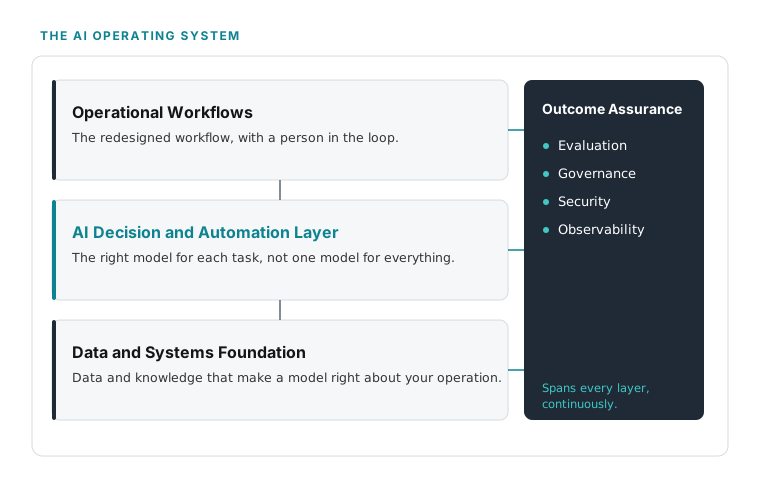
Four things have to be true at the same time. They line up, almost exactly, with the way we already build. We call it the AI Operating System.
The AI can reach your information. Your data, your documents, and the hard-won knowledge that make a model right about your operation rather than the world in general. A contract-review assistant is only as good as the clause library it can actually get to. Get this wrong and the model is confidently, fluently wrong.
The right model does each job, and no model does everything. A smaller model tuned to one narrow, repeatable step often beats a big general one and costs less to run. Which model goes where is an engineering decision, not a branding one.
The workflow itself changes. Not a chatbot stapled to the old process. The steps, the handoffs, and who decides what all get rebuilt around what AI can now do, with a person in the loop wherever judgment or liability calls for it. This is the spine of the build. It is where we spend the most, and it is the part a demo never has to solve.
Somebody is still checking, after launch. Testing, governance, security, and the ability to see what the AI did and why are not a separate box bolted on top. They run across the other three all the time, so you always know whether the workflow is still moving the number it was bought to move. We have written about that discipline on its own. You measure for as long as the workflow runs, not once before go-live. This is the real difference. It is the part a bolt-on build saves for last, if it gets there at all.
Where the hard part actually was
Here is a real one. We built a finance workflow for a Canadian healthcare services company. It pulled figures out of a stack of documents, some neatly structured and some not, sorted them into categories, and turned them into an output an analyst could sign.
The model reading the numbers was the easy part. The real work came first. We had to understand the domain well enough to know what each figure meant, track down every document and rule the output depended on, and get all of it clean and consistent. Miss a source, misread a label, or feed it messy inputs, and the model hands back something that looks polished and is quietly wrong.
Accuracy took more than a good model, too. A general model is fluent and approximate, which is the opposite of what a financial output needs. So we wrote step-by-step procedures for each specific task the work demanded, so the model followed the firm's method instead of improvising one, and we connected the model to real tools and live sources through the Model Context Protocol, the emerging open standard for making those connections. Exact calculations ran as code, not as guesses. Research reached current sources, not the model's memory. The model coordinated the work; the tools did the parts they are good at.
None of that is the model. The information, the written procedures, the tools, and a person in the loop did the heavy lifting. A bolt-on build skips to the answer and never does that work. That is the whole point.
A thirty-second test for a stuck pilot
If you have a pilot stuck between a great demo and real use, you can usually find the missing piece fast. Ask three questions.
Can the AI reach your real data and your real rules, or is it working from a clever prompt and a sample set?
Did the workflow actually get redesigned, or did someone point AI at the old steps and hope?
Is anyone tracking the business number the pilot was meant to move, on a schedule, and not just the model's scores on a dashboard?
A "no" to any one of those three is usually where the pilot is dying.
"But the models are good enough now"
The serious version of the argument deserves a hearing, and it runs like this: today's best general-purpose models are good enough that most of the job is a well-prompted model with clean information behind it, and extra machinery just slows delivery down and makes problems harder to trace. Start simple. Add complexity only when the simple version fails. That is good engineering advice, and it is not the argument being made here.
It is also exactly why the pilots demo well and then stall. Real use is where the missing data, the un-redesigned workflow, and the absent measurement all surface at once, which is what MIT measured. And even the keep-it-simple camp pairs simple prompts with serious testing. A lean model layer is not an argument against the checks around it. It makes them matter more.
The decision in front of you
The real choice is not which model to buy. Models keep converging. The choice is whether your next AI build is a model bolted onto a process, or a workflow rebuilt around one, with the measurement running from day one. That is what separates the pilots that get quietly cancelled from the ones that move a number your board can see.
It is also why the first workflow we rebuild is typically running live in your operation in five to seven weeks, and why the number it was bought to move is still being measured a quarter after launch, with any drift traced back to the assumptions behind it. Not because our model is better. Because the system around it was built to hold, and because we do not rebuild it from scratch each time. The reusable pieces are our accelerators.
If you have a pilot that demoed beautifully and never shipped, you already know the workflow. That one goes straight to a Transformation Blueprint: we watch the work as it actually runs, agree the numbers it will be measured against, and price the build before you commit real money. If you have a dozen candidate ideas and no clear first workflow, that is an AI Jumpstart. Either way, the model is the easy part. We will show you the rest.
See where AI will pay off in your operations.
Pick one workflow that matters to you and answer a few focused questions. You get a workflow-specific read on where AI can move a real number for you. It also names what stands in the way and the right first step for your situation.
A clear read on the one workflow you choose, not a generic AI-readiness label or a roadmap you will never use.
Email required after the fifth question. Your results are built around the workflow you name.
What you receive
- A workflow-specific read on the one process you choose, not a generic AI-readiness label
- The risks that would block, slow, or add cost to change, and the minimum work to clear each one
- A view of what a short self-serve scan can and cannot see
- One recommended first step, reasoned from your own answers
- A three-line summary you can forward to a CFO or CEO in one paste
Prefer to go straight to scoping, or talk to an engineer?